How to get a world-class score

Getting a top score on The Customer Test isn’t about marketing language. It’s about what you show publicly — the specific signals that tell customers, investors, and employees that you take the relationship seriously. Here are the 10 things that matter most.

How a 10/10 breaks down

T1 · Language
3/3
T2 · Programme
3/3
T3 · Measurement
3/3
T4 · Commitment
1/1

The principle

Every point must be earned through public evidence. It doesn’t matter what you say internally — it matters what a customer, investor, or journalist can find on your website, in your annual report, or in your earnings calls today.

Most companies fail on T2 and T3 — they use customer language, but don’t show the systems and proof behind it.

What does good look like?

Our research is all about highlighting companies that show public commitment to customer centricity. Of course, many companies may have world-class programs measuring and acting on customer feedback — but if they’re not showing it to the public, they miss the opportunity to prove it to customers and future clients.

Conversely, the companies that transparently show how they operate their program, and show evidence of this, are what we call “world-class”. We believe that B2B companies have the opportunity to have better customer experience by communicating about their programs to their customers, employees and investors. It’s an easy step for companies to take. Many have a functional customer listening program — now is the time to tell the world about it. The first step is taking some corporate courage and being transparent.

As far as we know, there are no guidelines or standard methodologies for presenting customer experience programs. This project — TheCustomerTest — is our first steps in codifying what “good looks like”.
Here are some of what we consider world-class examples in presenting customer centricity. Have more examples to share? Let us know.
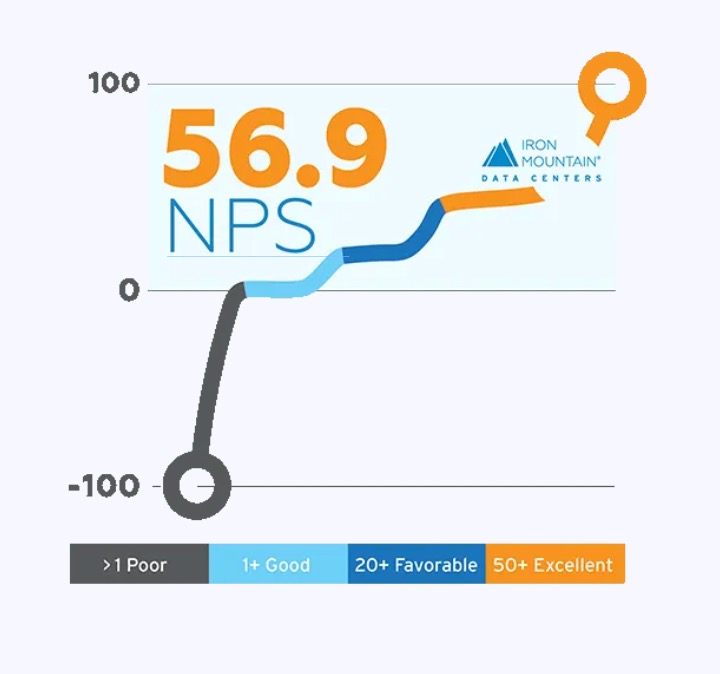
Iron Mountain publishes a Net Promoter Score of 56.9 on their customer solutions page View source
Iron Mountain A+ · Score 10

Iron Mountain talk about their commitment to customers, and publish their Net Promoter Score of 56.9 directly on a public customer-facing page. A specific number, benchmarked against Bain & Company’s NPS bands, presented with pride.

ironmountain.com · open in new tab
JPMorgan Chase: We focus on the customer View source
J.P. Morgan Chase Business principles

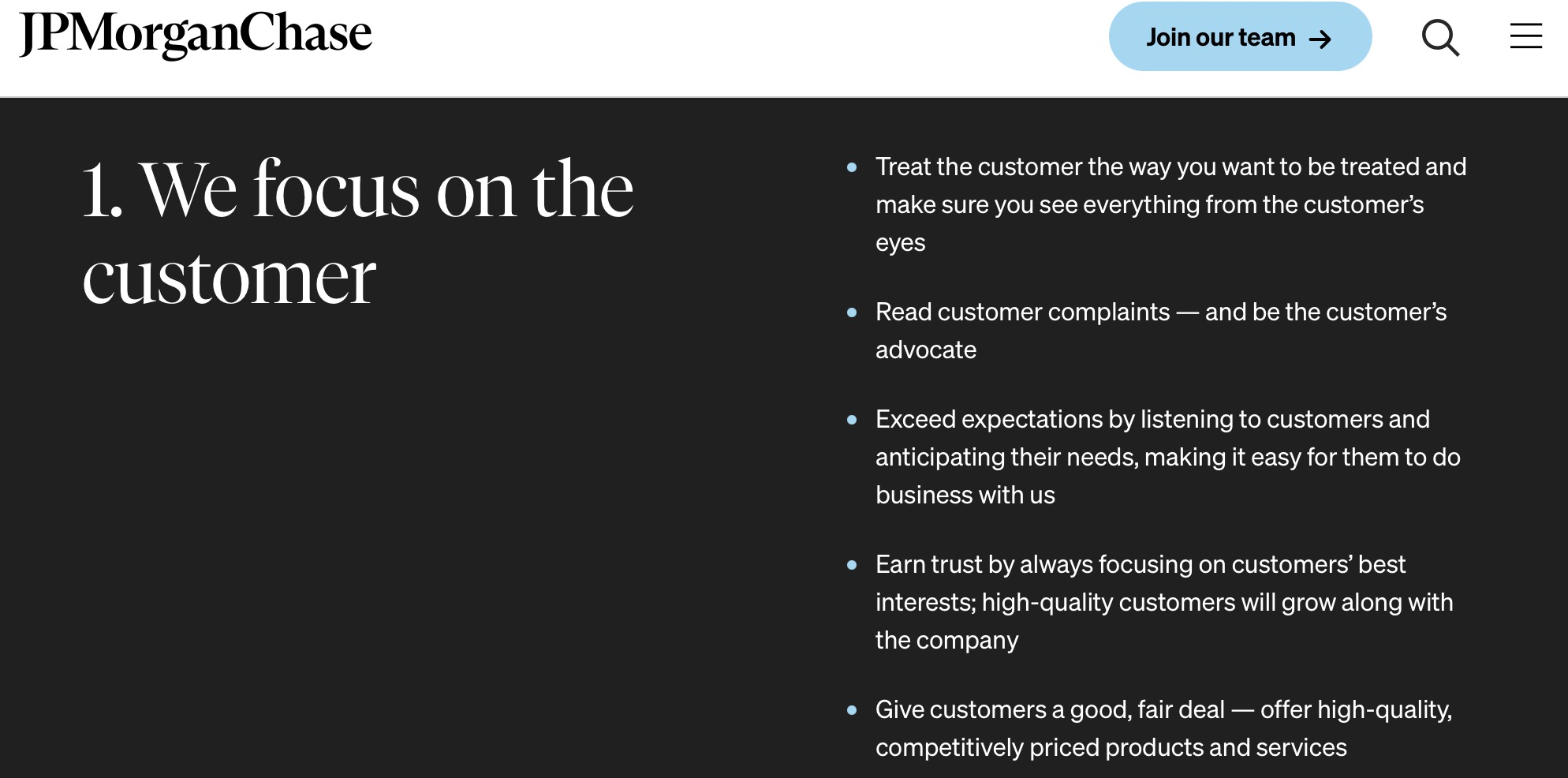
J.P. Morgan clearly state “We focus on the customer” as principle #1, and use the Golden Rule: “Treat the customer the way you want to be treated and make sure you see everything from the customer’s eyes.” CEO Jamie Dimon talks about customers frequently in his shareholder letter — in contrast to many other CEOs who don’t mention their clients.

jpmorganchase.com · open in new tab
JPMorgan Chase 2025 investor day: ~65 NPS in 2024, record high, +5pt since 2019 View source
J.P. Morgan Chase Investor day deck

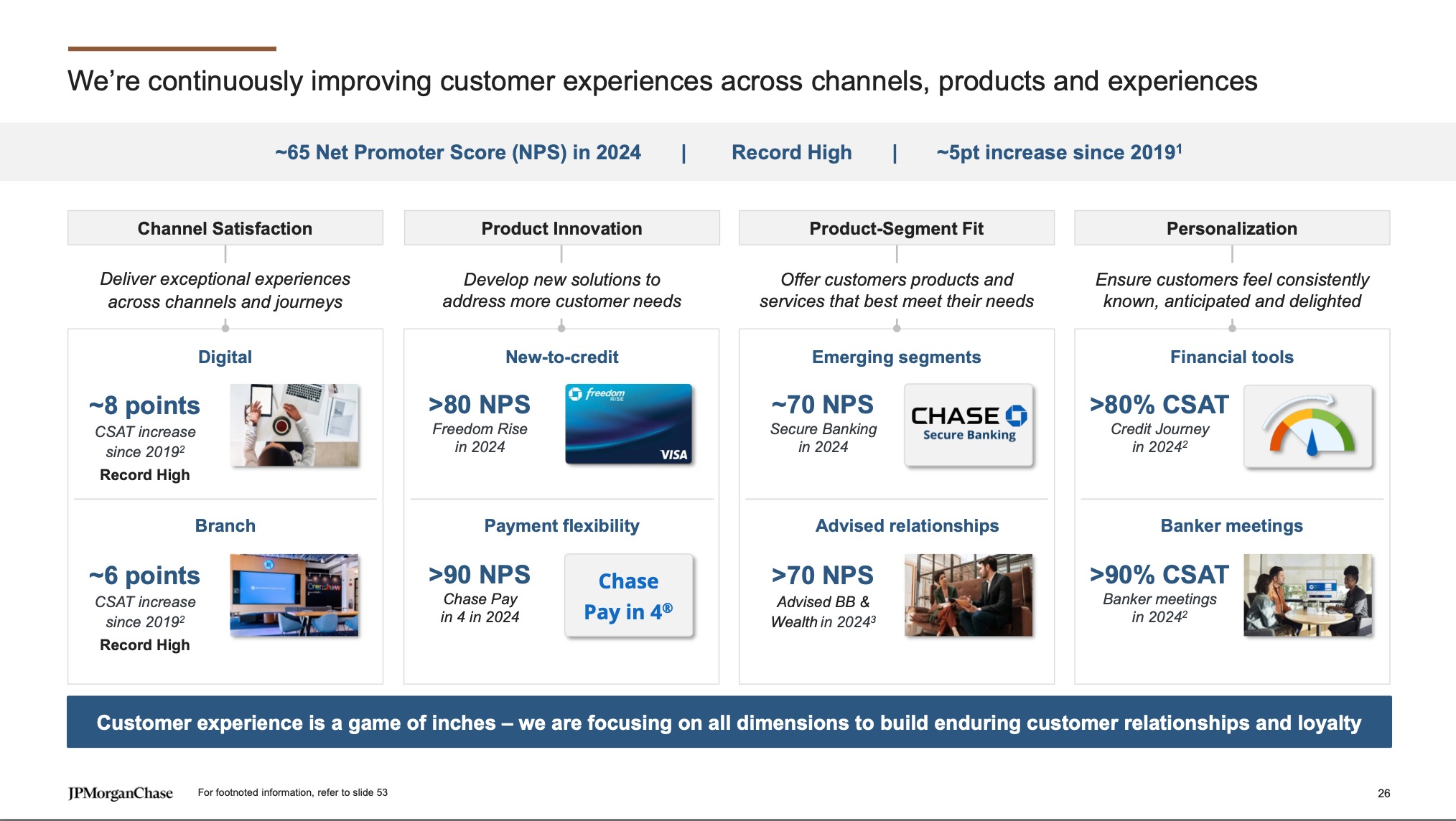
J.P. Morgan also go into detail on their NPS program and scores. It’s a little more hidden in their investor documents, but it’s clear they measure it: “~65 Net Promoter Score (NPS) in 2024 · Record High · ~5pt increase since 2019” — with per-product breakdown (>80 NPS Freedom Rise, >90 NPS Chase Pay in 4, >80% CSAT Credit Journey).

2025 Consumer & Community Banking Investor Day (PDF) · open in new tab
Coca-Cola HBC: Evolving our customer satisfaction approach View source
Coca-Cola HBC A+ · Score 10

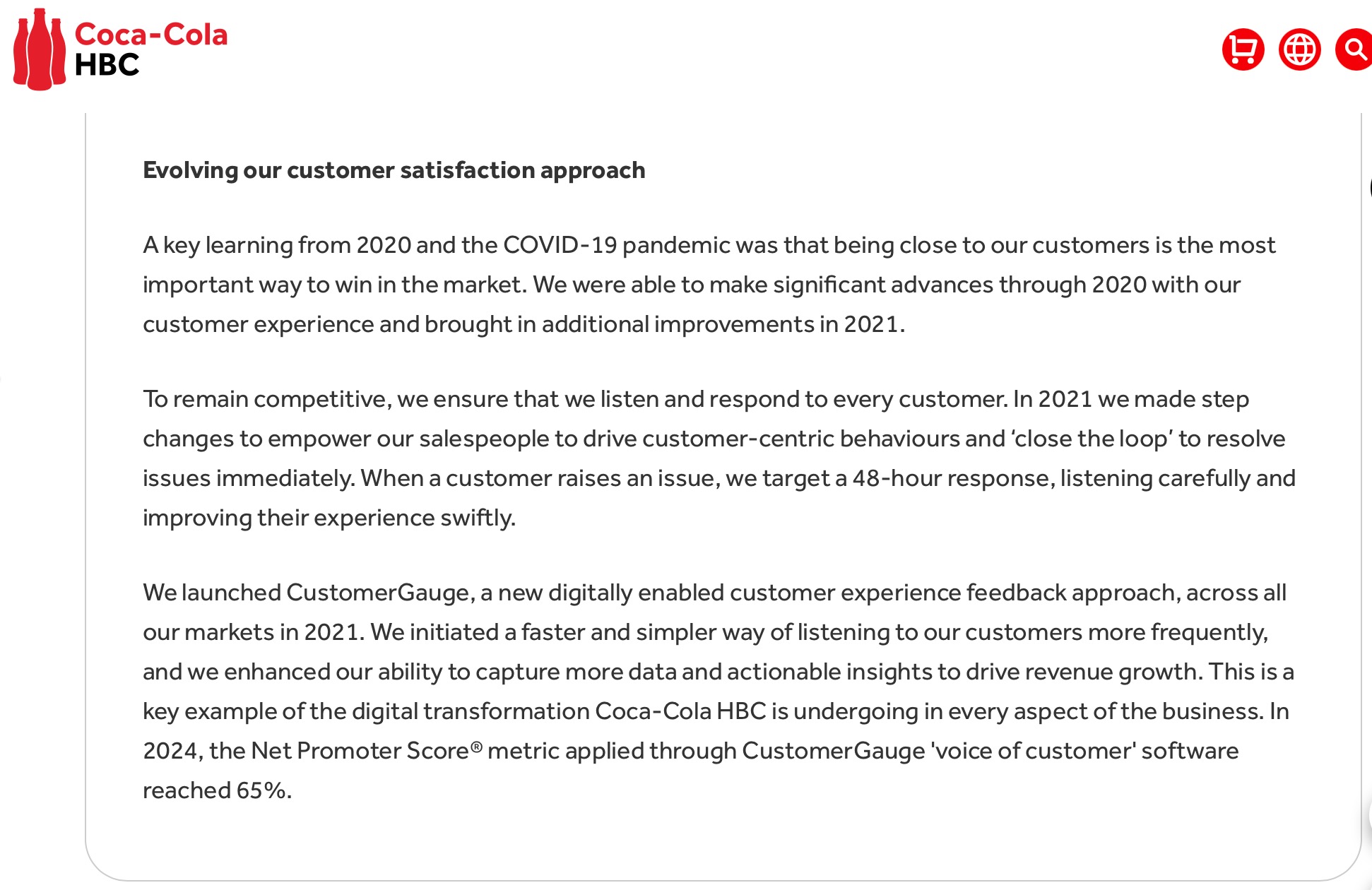
Leading Coca-Cola bottler Coca-Cola HBC show clearly their commitment to their B2B partners on their “About Us” web page: “We ensure that we listen and respond to every customer.” Full detail of their Net Promoter Program is given in their Annual Report — launched CustomerGauge across all markets in 2021, and the Net Promoter Score reached 65% in 2024.

coca-colahellenic.com · open in new tab
Know another world-class example? Send it in →
Addendum · May 2026

How public companies talk about NPS in their annual reports

Companion piece to our white paper Why customers don’t respond. After that paper’s publication we extended the analysis to roughly 3,000 NYSE- and NASDAQ-listed companies, asking a single question: which of them publish an actual Net Promoter score in a public document, and how do the strongest examples frame it?

Across the full audit, only 52 companies publish an actual NPS score or visible trend in a publicly accessible document — annual report, sustainability report, S-1, earnings release, or investor presentation. The rest mention the methodology in passing, talk about “customer satisfaction” without a number, or stay silent. The gap between intent and disclosure is wider than the industry talks about.

What the strongest disclosures share is that the score has been put somewhere it cannot easily retreat from — a filing, a target, a public commitment. That is the move that distinguishes a programme from a survey. The strongest examples we found, grouped by where the disclosure sits.

In the SEC-filed 10-K

The strongest possible context. The score sits inside the audited annual filing, having passed through both legal and investor-relations review.

United Parcel Service NYSE: UPS
Scorecard →
2024 Annual 10-K / Proxy · look for the “Customer First” section
We track progress in Customer First by improvements in our Net Promoter Score (NPS). In the U.S., we finished the year with a NPS of 44 and moved closer toward our target NPS of 50.
UPS publishes both the score and the target — a pattern almost no-one else in the dataset follows. Framing NPS as the measure of a named corporate programme (“Customer First”) elevates it from a departmental metric to an enterprise KPI the CEO has to defend on the earnings call.
Opendoor Technologies NASDAQ: OPEN
Scorecard →
FY2020 Form 10-K (SEC) · Item 1 — Business / Our Customers
Due to our focus on delighting the customer, we have a best-in-class Net Promoter Score of 70 from our sellers.
A simple, confident statement in the business-overview narrative of a 10-K. The “best-in-class” claim is a filing, not a marketing line — meaning it carries securities-law accountability.
Jamf Holding Corp. NASDAQ: JAMF
Scorecard →
FY2024 Form 10-K (SEC) · Item 1 — Business / Customer Support
We strive to provide the best possible support for our customers and maintained a high customer satisfaction score of 9.34 out of 10 in 2024 based on our surveys.
Jamf cross-references this in its Purpose & Impact Report with an NPS of 55, well above industry standard. Two documents reinforcing the same number is a strong signal of programme maturity.

In the S-1 / IPO prospectus

A distinct pattern: companies bake NPS into the prospectus to signal product-market fit at the moment of greatest scrutiny.

Affirm Holdings NASDAQ: AFRM
Scorecard →
S-1 Registration Statement, 2020 · Business — Why We Win
… an industry-leading average NPS of 78 from December 2019 through June 2020.
A 78 over a defined period is a measurable, defensible figure. The S-1 disclosure means underwriters and the SEC have both seen it — there is nowhere to hide if it later proves unrepresentative.
DocuSign NASDAQ: DOCU
Scorecard →
S-1/A IPO Filing, 2018 · Business — Our Customers
… reflected by our strong Net Promoter Score of 63 as of October 2017.
A point-in-time disclosure tied to an exact month. The dating discipline matters: it makes the figure auditable.
Fastly NASDAQ: FSLY
Scorecard →
S-1/A IPO Registration Statement, 2019 · Prospectus Summary — Customer metrics
64 Net Promoter Score (As of December 2018). Net Promoter Score is a third-party measurement of customer satisfaction that was developed by Bain and Co.
Fastly goes further and explains the methodology in the prospectus itself, anticipating that public-market investors may not be familiar with the metric. A useful pattern for any company introducing NPS to a generalist investor base.

In earnings releases and investor materials, with movement

The disclosures that work hardest are those that show direction over time, not just a snapshot.

Shenandoah Telecommunications NASDAQ: SHEN
Scorecard →
Q4 2025 Earnings press release · Customer satisfaction commentary
High customer satisfaction, evidenced by a Net Promoter Score of 61, serves as the primary defense against cable competitors and maintains low churn levels near 1%.
The most causally-claimed disclosure in the entire dataset. Shentel does not just publish the score — it tells investors what the score does, linking NPS directly to churn and competitive defence. The pattern most likely to convert a sceptical CFO.
AvalonBay Communities NYSE: AVB
Scorecard →
Q3 2025 Earnings release + ESG Goals page · Operating commentary & ESG resident goals
… a near all-time high mid-lease Net Promoter Score of 34, one of the metrics we utilize to measure customer engagement and with clear connections to retention and renewal outcomes.
AvalonBay also publishes a forward target — “Achieve Mid-Lease Net Promoter Score of 33 by 2025” — in its ESG goals. Once a target is committed publicly, missing it becomes a board-level conversation rather than an internal one.
Rentokil Initial LSE: RTO · NYSE: RTO
Scorecard →
2024 Preliminary Results PDF · Customer Experience section
Customer satisfaction was also positive, with an improved overall Net Promoter Score of +53.3.
A FTSE 100 industrial publishing customer-satisfaction movement in the same release as financial results. Rentokil’s investor materials elsewhere clarify that the figure is a branch-level average — methodology disclosure that shores up credibility.
Banco Santander Brasil NYSE: BSBR
Scorecard →
Q4 2025 Earnings presentation, 4 Feb 2026 · Customer experience slide
… a unified payment journey NPS of 84 points.
Journey-level rather than relationship-level NPS, disclosed inside an earnings presentation. A useful pattern for any business that wants to disclose specific touchpoints rather than a single composite score.
Angi Inc. NASDAQ: ANGI
Scorecard →
Q3 2025 Shareholder Letter · Operating highlights
Homeowner NPS improved +7 points vs 2024 and is now up +28 points vs 2023.
A two-year trend disclosed in a shareholder letter, alongside churn improvement. Trend over time is more credible than any single number, and Angi shows how to do this concisely.
Ball Corporation NYSE: BLL
Scorecard →
2024 Investor Day Transcript, 18 Jun 2024 · Customer commentary
Customers have just rated us an 8.4 out of 10 in terms of net promoter score … what that means is our customers are getting into this place where they’re advocates for us.
A B2B industrial materials company explaining NPS to capital-markets investors at its investor day. The “advocates for us” framing translates the metric into language investors already use about brand and revenue durability.

In sustainability and integrated reports

Where NPS is positioned alongside ESG metrics it inherits the same governance — board oversight, external audit pressure, and year-over-year disclosure expectation.

MetLife NYSE: MET
Scorecard →
2024 Sustainability Report PDF · 5-year highlights / KPI summary page
+23 points on relationship Net Promoter Score completed in the last 5 years.
MetLife reports the NPS movement alongside total shareholder return and other 5-year financial KPIs — a deliberate choice to put customer measurement on the same page as the metrics investors already track.
América Móvil NYSE: AMX
Scorecard →
Sustainability Goals page · Customer experience milestones
Increase the NPS by 1% in each country where we operate. Progress: The objective of 1% was achieved vs. the previous year, with a global NPS of 41.
Country-level public targets, with progress disclosed against them. A model for any multi-market business that wants to make the metric ungameable: every country has its own number, every number is reported.

What the disclosures reveal

Three patterns separate the strongest examples from the rest, and they reinforce the central finding of the white paper.

1. The number is paired with a target. UPS publishes “44, moving toward 50”. AvalonBay publishes “34, with a goal of 33 by 2025”. Coca-Cola HBC publishes “65%, up from 56%”. A score on its own is a measurement; a score paired with a target is a programme. The presence or absence of a target is the cleanest single test of programme maturity.

2. The number is paired with an operational KPI. Coca-Cola HBC pairs NPS with 99% of customer issues resolved within 48 hours. Shenandoah pairs it with churn near 1%. Rentokil pairs it with branch-level coverage. The pairing is what makes the number believable — it shows the score is connected to something a manager actually does, not generated by a survey nobody reads.

3. The number lives in a document the CEO has to defend. The 52 companies that publish a score have made it part of the formal investor narrative. Once it is there, the cost of letting the programme drift becomes career-relevant rather than departmental. This is the structural reason public disclosure outperforms internal dashboards: it changes who is paying attention.

Each of these patterns is, in different vocabulary, the same finding as the white paper. The clients who break the volume-versus-engagement trend are the ones whose customers expect the survey to matter. The public companies that publish a credible score are the ones whose investors expect the programme to deliver. Different audiences, identical mechanism: visible accountability is what converts opens into clicks, and what converts feedback into a number worth reporting.

Source: CustomerCentricityBenchmark audit database, May 2026. Approximately 3,000 NYSE- and NASDAQ-listed companies surveyed; 1,074 records with strong (Tier 3) customer-measurement evidence; 52 with an actual published score or trend. All quotations reproduce verbatim text from the public documents linked in the underlying audit.

10-point plan to improve your score

Ordered by impact. Each action maps to a specific scoring tier.

01
T3 · Measurement — highest impact
Publish your NPS score on your website
The single highest-leverage action. Add a page or section stating your current NPS, CSAT, or customer satisfaction score. Even a simple line like “Our NPS is 68” on your About or IR page earns full T3 credit. Fewer than 3% of listed companies do this.
Coca-Cola HBC: “The Net Promoter Score® metric applied through CustomerGauge reached 65%.” — published on their public website.
+3 points possible
02
T3 · Measurement
Reference NPS in your investor materials
Mention NPS, CSAT, or customer satisfaction scores in your annual report, earnings call, or investor presentation. Even without the specific number, naming the metric signals you manage by it. This earns T3a and potentially T3b.
United Airlines: “Highest fourth-quarter customer satisfaction score in its history as measured by Net Promoter Score” — in 8-K filing.
+1–2 points
03
T2 · CX Programme
Name your CX programme publicly
Give your customer experience approach a name and describe it on your website: “Our Customer Success Programme” or “Our Voice of the Customer system”. A named programme is searchable, credible, and real.
Oracle: “Customer Success Services” — a dedicated page describing adoption, outcomes, and guidance, with a named Chief Customer Success Officer.
+1 point (T2a)
04
T2 · CX Programme
Describe how you collect customer feedback
Publicly explain your feedback mechanism: surveys, Voice of Customer programmes, after-interaction feedback, closed-loop follow-up. Show that you listen systematically, not just when something goes wrong.
Essential Utilities: “Voice of the Customer survey after every interaction” — described publicly with 10% of executive pay tied to CX metrics.
+1 point (T2b)
05
T2 · CX Programme
Show evidence of acting on feedback
Don’t just collect feedback — show that you act on it. Reference closed-loop processes, continuous improvement, or specific changes made because of customer input. Include CX evidence in your annual or ESG report.
+1 point (T2c)
06
T4 · Commitment Depth
Appoint a named CX executive
A C-suite role with customer responsibility — Chief Customer Officer, VP of Customer Experience, or Chief Customer Success Officer — listed on your leadership page. This signals governance-level accountability.
Oracle: Gary Miller, Chief Customer Success Officer — named on the executive team page with a specific customer mandate.
+1 point (T4)
07
T4 · Commitment Depth
Tie CX metrics to executive compensation
Disclose in your proxy statement or annual report that customer satisfaction metrics are part of executive bonus calculations. This is the strongest governance signal — it means CX can’t be deprioritised when short-term pressure arrives.
Essential Utilities: “Customer experience targets make up 10% of the short-term incentive plan” — disclosed in ESG report.
+1 point (T4)
08
T1 · Language
Put customer language in your mission and values
Customer-first language should appear in your company’s stated identity — mission statement, corporate values, or About page — not just in marketing copy.
Amazon: “Earth’s most customer-centric company” — in their About Us, Leadership Principles, and every shareholder letter.
+1 point (T1a)
09
T1 · Language
Use customer language consistently across your site
Customer references should appear on the homepage, about page, investor relations, AND in reports — not just on one buried page. Consistency signals genuine priority, not a marketing add-on.
+1 point (T1b)
10
T1 · Language
Use operational customer language
Go beyond generic “we care about customers” — use specific operational terms: customer service, customer satisfaction, customer success, customer experience, service quality. This shows CX is embedded in operations, not just communications.
+1 point (T1c)

Gold standard: Coca-Cola HBC (10/10)

“We launched CustomerGauge, a new digitally enabled customer experience feedback approach, across all our markets in 2021. We initiated a faster and simpler way of listening to our customers more frequently, and we enhanced our ability to capture more data and actionable insights to drive revenue growth. In 2024, the Net Promoter Score® metric applied through CustomerGauge ‘voice of customer’ software reached 65%.”

This single paragraph earns points across all four tiers: customer language (T1), named programme with feedback mechanism (T2), published NPS score (T3), and named platform deployed globally (T4).

Even Apple scores 4/10

Apple — widely regarded as the gold standard for customer experience — scores only 4/10 on public evidence. They have customer language (T1) and some CX references (T2), but publish no NPS score (T3=0) and no governance signals (T4=0). This demonstrates that many companies run excellent CX programmes without making them publicly visible. The benchmark measures evidence, not reputation.

How does your company score?

Search the rankings to see your current grade, or read the methodology to understand each tier in detail.

Search rankings → Read methodology